Divorce Financial Disclosure Rules in England & Wales
Everything you need to know about Form E, financial disclosure obligations, pensions, business assets and the consequences of failing to provide full and frank disclosure during divorce proceedings in England and Wales.

Key points:
- ‘Full and frank’ financial disclosure is a legal duty owed to the court in every divorce financial case in England and Wales.
- Form E is the standard disclosure document, covering property, income, pensions, debts, and business interests.
- The Supreme Court in Sharland v Sharland [2015] UKSC 60 confirmed that fraudulent non-disclosure can unwind a financial order years later.
- Disclosure is an ongoing duty, so significant changes in circumstances after Form E is filed must also be disclosed.
- Third-party disclosure orders, forensic accountants, and adverse inferences are available where disclosure is inadequate or dishonest.
In Livesey (formerly Jenkins) v Jenkins AC 424, the House of Lords ruled that spouses going through divorce owe their duty of full and frank financial disclosure to the court, not just to each other. A spouse who conceals a bank account, undervalues a business, or fails to mention a pension scheme is viewed as misleading the court, and serious consequences can occur long after a settlement has been finalised.
What must a divorcing spouse disclose?
Both divorcing spouses must disclose every asset, income source, pension, and debt held anywhere, whether in their sole name or jointly. The Family Procedure Rules 2010 require both parties in financial remedy proceedings in England and Wales to exchange Form E, a standardised statement covering property, savings, investments, business interests, pensions, income, and liabilities. The form is signed with a statement of truth, meaning a false statement exposes the signatory to proceedings for contempt of court.
What is Form E used for?
Form E is the standard financial statement exchanged simultaneously by both spouses to give the court a complete financial picture. Form E requires supporting evidence, including bank statements, mortgage statements, pension valuations, payslips, tax returns, and business accounts. Any bank account closed within the preceding twelve months must still be listed.
Courts in England and Wales treat Form E as the primary evidential record when assessing fairness under section 25 of the Matrimonial Causes Act 1973.
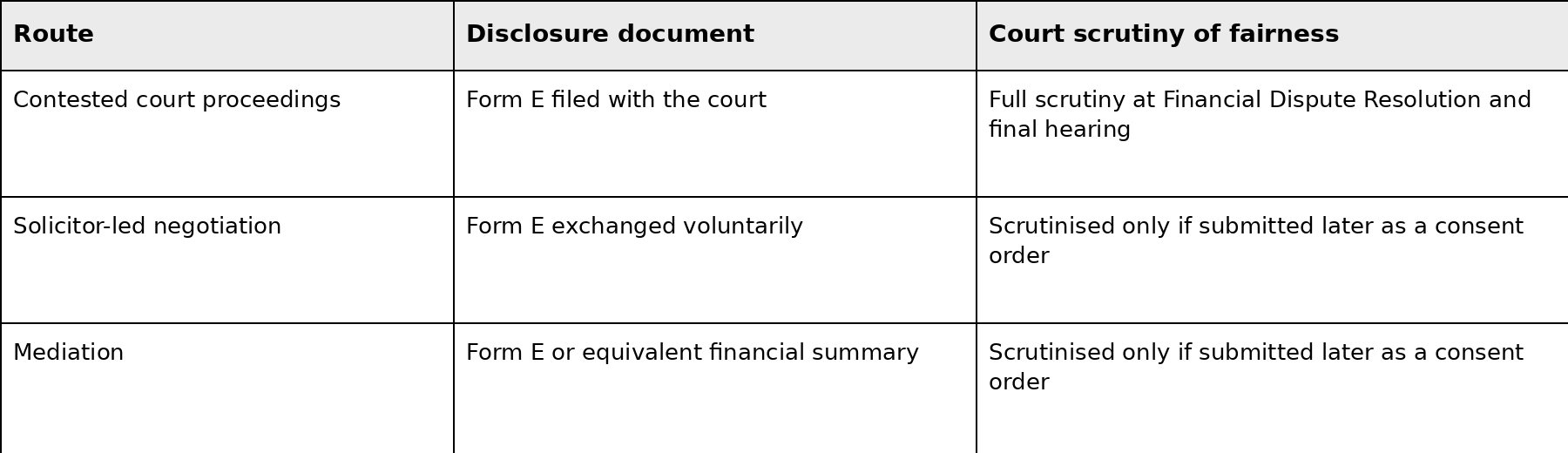
The table below compares the main routes through which disclosure can take place.
Does disclosure apply outside court?
Yes, the same duty of full and frank disclosure applies in mediation and solicitor negotiation, not only in contested proceedings. Couples in England and Wales who settle finances through mediation or direct negotiation still exchange Form E or an equivalent financial summary. If the agreement is later submitted to the court as a consent order, the court checks that the settlement is fair before approving it, and a consent order founded on incomplete disclosure can be set aside.
What if disclosure is dishonest?
Dishonest or incomplete disclosure allows the court to compel further evidence, draw adverse inferences, or set aside the final order.
In Sharland v Sharland [2015] UKSC 60, Lady Hale held that a victim of fraud in matrimonial proceedings should not be left “in a worse position than the victim of a fraudulent misrepresentation in an ordinary contract case”, and the Supreme Court set aside the consent order as a result. Also, under the Family Procedure Rules 2010, the family court can order third-party disclosure from banks, HMRC, or employers, appoint a forensic accountant, and impose a costs order against a spouse who fails to give full and frank disclosure.
How are pensions and businesses valued?
Pensions are valued using a Cash Equivalent Transfer Value, while business interests typically require several years of trading accounts. Each spouse must obtain a Cash Equivalent Transfer Value from every pension scheme held, though a CETV can understate a defined benefit pension and may need actuarial valuation. A spouse with a business interest will usually need to produce at least three years of trading accounts, and the court may appoint a single joint expert accountant in contested cases.
Final words
Financial disclosure in divorce proceedings in England and Wales should always be handled honestly and completely, even if a spouse is concerned that the other party may not do the same. A court that finds one spouse has withheld information will typically take a dim view of that conduct and adjust the financial award accordingly.
For a free consultation regarding financial disclosure or any other aspect of your divorce, please call us on 0208 300 6666.
Frequently asked questions
What happens if an asset is left off Form E by mistake?
The spouse should tell their solicitor immediately and correct the disclosure without delay. Courts in England and Wales treat a promptly corrected accidental omission far less seriously than a deliberate one, and swift correction reduces the risk of the omission being treated as material non-disclosure later in proceedings.
The spouse should tell their solicitor immediately and correct the disclosure without delay. Courts in England and Wales treat a promptly corrected accidental omission far less seriously than a deliberate one, and swift correction reduces the risk of the omission being treated as material non-disclosure later in proceedings.
Yes, a financial order can be reopened after disclosure fraud, even years after it was made. Sharland v Sharland [2015] UKSC 60 confirmed there is no fixed time limit where fraud or material misrepresentation is proven, and the affected spouse can apply for the order to be set aside.
Does financial disclosure apply during mediation?
Yes, financial disclosure applies during mediation in exactly the same way as in court proceedings. Both spouses must exchange full details of assets, income, and pensions before reaching an agreement, and any resulting consent order submitted to the family court will still be checked for fairness.
Last reviewed: July 2026