How Long Does Divorce Take? How to Get a Divorce in 2026
A practical guide to no-fault divorce, timescales, costs, finances and children in England and Wales.

If you are considering divorce, two questions often come first: “How long will it take?” and “How do I start?” The answer depends on the legal waiting periods, how quickly the court deals with your application and whether there are separate matters to resolve concerning property, pensions, finances or children.
Short answer: In England and Wales, the no-fault divorce procedure has a statutory minimum of approximately 26 weeks from issue of the application, consisting of a 20-week period before a conditional order may be applied for and at least 6 weeks and one day between conditional and final orders. In practice, cases frequently take longer. The Ministry of Justice recorded a median of 40 weeks between application and final order for cases reaching that stage in April–June 2026. Financial negotiations or children arrangements may continue separately.
This KLR Solicitors guide explains the process step by step, who can apply, what it costs and the decisions to consider before legally ending your marriage. The legal procedure described below is for England and Wales, not Scotland or Northern Ireland.
Who can apply for a divorce in England and Wales?
You can normally apply if you have been married for more than one year, your marriage is legally recognised in the UK, and it has broken down irretrievably. You must also establish that the courts of England and Wales have jurisdiction over your divorce; this is especially important if either spouse lives abroad or there are international connections.
Since April 2022, the no-fault divorce system means you do not need to allege adultery, unreasonable behaviour or a period of separation. A statement that the marriage has irretrievably broken down is sufficient for the ground of divorce. An application may be made by one spouse or, if appropriate, jointly. There are limited legal grounds for challenging the proceedings, but a spouse cannot usually stop a divorce simply because they disagree with the decision to divorce.
How long does divorce take in 2026?
The shortest ordinary legal route is about six months after the court issues the application, provided each stage is progressed promptly. This is a statutory minimum, not a typical promise or service standard. Actual waiting times depend on the court’s workload, correct paperwork, whether service is straightforward and other circumstances.
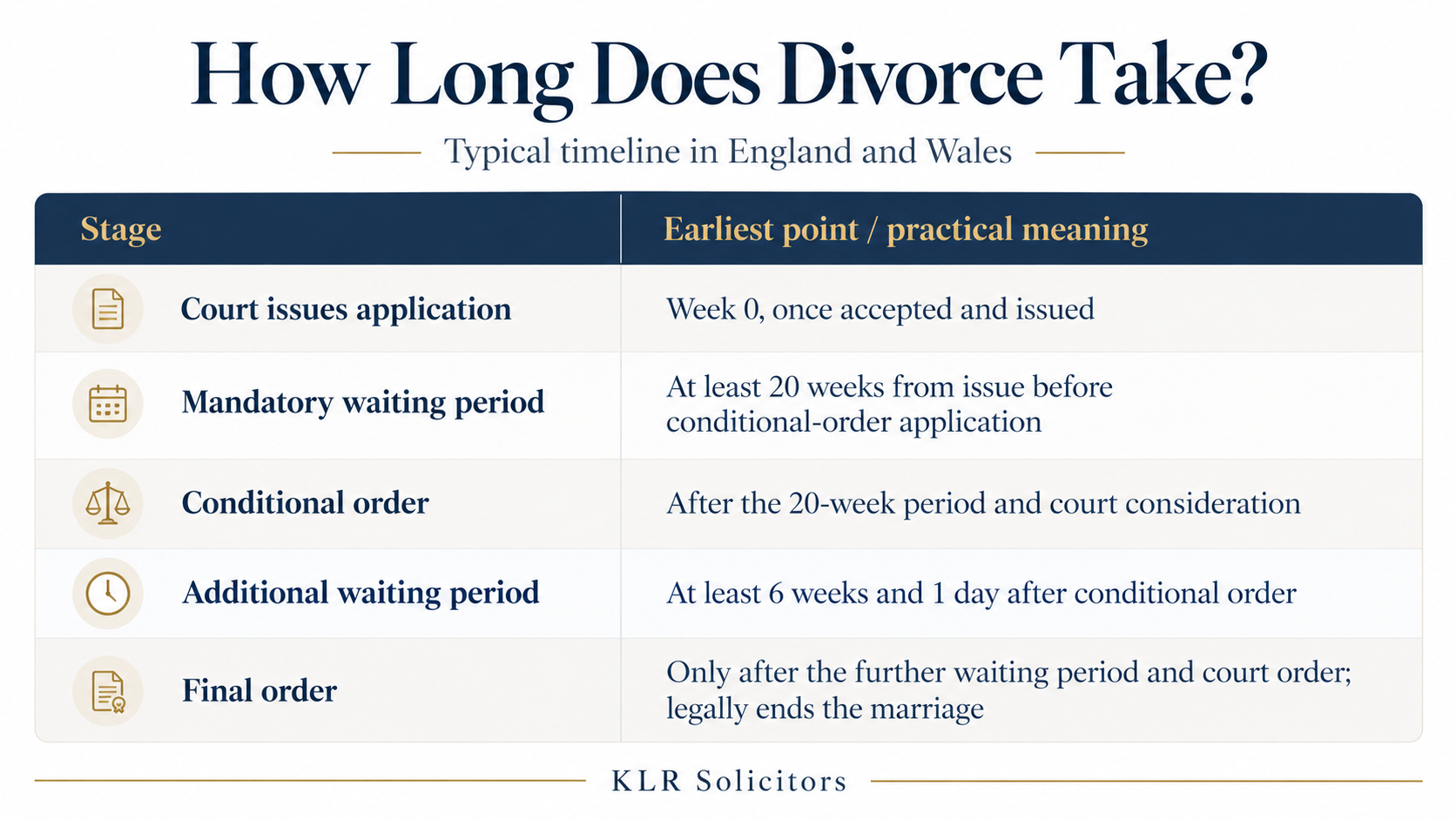
For context, official Ministry of Justice data for April–June 2026 shows a median of 28 weeks to conditional order and 40 weeks to final order. These are observed court figures, not a forecast for any one case. The same report recorded mean times of 40 and 68 weeks respectively; the mean is affected more heavily by older, long-running cases.
How to get a divorce: the legal process step by step
Step 1 — Prepare your application
You will need your marriage certificate (or a certified copy), the names and addresses of both spouses, and any necessary translation or proof of name change. Check the correct legal jurisdiction and whether a sole or joint application is more appropriate. If you have concerns about safety or sharing contact information, seek advice before filing.
Step 2 — Apply online or by post
Most people can use the GOV.UK divorce service. You can apply as a sole applicant or jointly with your spouse. The court application fee listed by GOV.UK on 29 October 2026 is £628. Eligibility-based Help with Fees may reduce the cost. Solicitor charges for advice and representation are separate from the court fee.
Step 3 — Court issues the application and the other spouse is notified
The court checks and issues an accepted application. In sole applications, the respondent is usually served with the application and asked to acknowledge receipt; the normal response period is 14 days. If the respondent cannot be located or does not respond, additional steps may be necessary, which can delay proceedings. There are limited grounds on which an application can be disputed.
Step 4 — Wait 20 weeks and apply for a conditional order
The mandatory 20-week period starts when the court issues the divorce application, not simply when you decide to separate or begin filling in the form. Once that period has passed, the applicant can ask the court for a conditional order, which confirms the court is satisfied the legal requirements have been met. A conditional order does not itself end the marriage.
Step 5 — Consider the financial settlement and children arrangements
During the waiting periods, it is sensible to address financial disclosure and possible agreements over the family home, pensions, savings, debts and maintenance. Where both parties agree, a solicitor can prepare a proposed financial consent order and ask the court to approve it. Generally, the court cannot approve a divorce financial consent order before conditional order, and it usually takes effect when the final order is made.
If you have children, decisions about where they live, the time they spend with each parent and financial support can often be agreed separately without a contested court hearing. The divorce application itself does not automatically settle these issues. Mediation and other non-court approaches may help where suitable and safe.
Step 6 — Apply for the final order
At least 6 weeks and one day after the conditional order, the applicant can apply for the final order. When the court grants it, the marriage legally ends. However, it can be financially important not to rush this step: the final order may affect pensions, inheritance-related benefits or other entitlements, and financial claims may remain unresolved.
Take tailored advice on the timing, particularly where substantial assets or pensions are involved.
What might make a divorce take longer?
- Court processing times and administrative backlogs.
- Incorrect or incomplete details, documents or translations.
- Difficulty serving a spouse or establishing where they live.
- International circumstances, jurisdiction questions or limited legal objections.
- A decision to wait for financial protection or approval of a consent order before final order.
- Complex or disputed financial issues, such as business interests, pensions or property valuations.
- Separate disputes about children and any safeguarding concerns.
A divorce can proceed legally while financial or children matters are being addressed separately. Consequently, there is a difference between “how long to become divorced?” and “how long until everything is resolved?”
How much does a divorce cost?
The published court fee to make a divorce application is £628 as at 29 October 2026. A person on a low income or certain benefits may qualify for Help with Fees. Additional costs depend on whether you obtain legal advice, agree a financial settlement, need to apply for a court-approved consent order or become involved in contested proceedings. Ask your solicitor for a personalised estimate of legal fees, VAT and any court charges; do not assume that the divorce application fee covers a financial settlement.
Are divorce and financial settlement the same thing?
No. The final order ends the marriage but does not, by itself, divide property or pensions or automatically dismiss possible financial claims. An agreed settlement generally needs a court-approved financial consent order to become legally binding. A clean break, where appropriate, can help define and end future financial obligations. If the parties cannot agree, the court may be asked to decide through financial remedy proceedings. This can take significantly longer and incur additional costs.
What happens if children are involved?
Parents can often agree living arrangements, contact and child maintenance without a court order. If agreement is difficult, a mediator or family solicitor may help. If an application to court is required, the court focuses on the child’s welfare. A mediation information and assessment meeting is usually required before certain applications, subject to exemptions. Where there is domestic abuse or risk of harm, safety and appropriate legal protection take priority.
Can you get a divorce without your spouse agreeing?
Usually yes, under the no-fault system. A sole application does not generally require agreement to the marriage ending. The respondent must still be properly notified or the court must permit another lawful route where service cannot be completed. If your spouse does not respond, seek guidance rather than assuming the application automatically fails.
Can you divorce without a solicitor?
It is possible to make a divorce application personally through GOV.UK. Legal advice is particularly valuable where there are pensions, property, business assets, dependent children, international factors or uncertainty about financial settlement. Applying without advice does not eliminate the need to consider a binding financial order.
Frequently asked questions
Can I divorce before we have been married a year?
Not through the ordinary divorce procedure in England and Wales. Other options, such as judicial separation or annulment, may apply in specific circumstances.
Do I need to prove someone was at fault?
No. Since April 2022, the ground is that the marriage has irretrievably broken down; fault-based allegations are not required.
Does the 20-week period run from separation?
No. It runs from when the court issues the divorce application.
What is the difference between a conditional order and final order?
A conditional order confirms the court sees no legal reason the divorce cannot proceed. A final order legally ends the marriage.
Can the court shorten the statutory waiting periods?
The ordinary process includes mandatory waiting periods. Exceptional legal circumstances require individual advice; do not assume the court will shorten them.
Will the final order settle our finances?
No. You should consider whether a financial order is needed, including a clean break where appropriate.
Does a joint application take less time?
Not necessarily. Practical cooperation may help, but the legal waiting periods apply to both joint and sole applications.
How long does a divorce take if we agree everything?
It still cannot ordinarily bypass the minimum statutory periods. Prompt paperwork and a straightforward case may reduce avoidable delays, but court timings vary.
Speak to KLR Solicitors about divorce and separation
Understanding the legal timeline is only part of planning a separation. KLR Solicitors can be contacted to discuss the divorce procedure and the legal issues that may arise around finances, property, pensions and children. Ask the family law team for advice tailored to your circumstances and a clear explanation of likely fees before instructing.
This is general information about the law of England and Wales, accurate to the extent checked on 29 October 2026, and is not legal advice. Scotland and Northern Ireland have different processes. Laws, official fees and court processing times may change.