Should I Stay for the Children? Understanding the Impact of an Unhappy Marriage
Exploring the emotional impact of staying together for the sake of your children, and how to make informed decisions that protect the wellbeing of your family.

Should I Stay for the Children? Understanding the Impact of an Unhappy Marriage
Few decisions in life feel as difficult as considering the end of a marriage when children are involved.
As a parent, your natural instinct is to protect your children. You want them to feel safe, loved and secure, and the thought of disrupting their family life can be incredibly painful.
You may find yourself wondering whether your own happiness should come second to maintaining the family home.
Perhaps you have told yourself that you will wait until the children finish school, leave for university or become old enough to understand.
You may have become so accustomed to putting your children's needs first that you have stopped considering your own emotional wellbeing altogether.
But what if staying together is not necessarily protecting your children in the way you had hoped?
At KLR Solicitors, we recognise that there is no simple answer to this question. Every family is different, and deciding whether to remain together or separate requires careful thought, understanding and the right support.
Is staying together always better for children?
Many parents understandably associate a stable childhood with growing up in a home where both parents live together.
A loving, supportive household can provide children with an invaluable sense of security. Where relationship difficulties can be resolved and mutual respect restored, remaining together may be a positive outcome for the entire family.
However, living under the same roof does not automatically create emotional stability.
A household characterised by persistent arguments, resentment, hostility, emotional withdrawal or unpredictable behaviour can become a source of stress for children.
Research highlighted by the UK Government's Reducing Parental Conflict programme identifies frequent, intense and unresolved parental conflict as a significant risk to children's mental health and longer-term wellbeing.
This does not mean that divorce is automatically better for children. Separation can also bring emotional, practical and financial difficulties.
What matters is understanding the environment in which your children are growing up and whether that environment can become healthier, together or apart.
The question is not simply whether your children should grow up with both parents under one roof, but whether they are growing up in an environment where they feel emotionally safe, secure and loved.
Children often notice more than we realise
Parents frequently make considerable efforts to protect their children from relationship difficulties.
You may avoid arguing in front of them, wait until they are asleep to discuss problems or continue attending family events together to maintain a sense of normality.
However, children can be remarkably sensitive to changes in the emotional atmosphere around them.
They may notice when conversations become strained, when affection disappears, when a parent becomes withdrawn or when family life feels increasingly tense.
Even without understanding the reasons behind these changes, children can experience uncertainty and anxiety.
Some children may begin to:
- Worry excessively about their parents' happiness.
- Feel responsible for keeping the peace at home.
- Become withdrawn or unusually quiet.
- Experience difficulties sleeping or concentrating.
- Show changes in behaviour or school performance.
- Avoid discussing their own problems because their parents appear stressed.
- Feel frightened about the possibility of their family breaking apart.
- Believe that they are somehow responsible for the difficulties.
These behaviours can have many causes and do not automatically indicate that parental conflict is responsible.
However, they may be reasons to pay closer attention to your child's emotional wellbeing.
Cafcass – Supporting Your Child Through Divorce and Separation provides guidance on recognising children's emotional responses and supporting them through difficult family circumstances.
What are we teaching our children about relationships?
Children learn about relationships not only through what we tell them, but also through what they experience at home.
They observe how adults communicate, handle disagreements, express affection, establish boundaries and respond to emotional difficulties.
When considering your own relationship, it may be helpful to ask what your children are learning from the interactions they witness.
Are they seeing two people who respect each other, even when they disagree?
Are they learning that problems can be resolved through communication and understanding?
Or are they beginning to believe that love means tolerating unhappiness, suppressing emotions or accepting disrespect?
These are difficult questions, particularly when you have spent years trying to do what you believe is best for your family.
This is not about assigning blame. It is about recognising that the relationship your children grow up observing may influence their own expectations of relationships in adulthood.
The difference between a difficult period and an unhealthy relationship
Every marriage experiences difficulties.
Financial pressures, demanding careers, parenting responsibilities, illness, bereavement and exhaustion can all place considerable strain on a relationship.
Experiencing unhappiness does not necessarily mean that a marriage has reached its end.
There may still be mutual affection, a willingness to listen and a genuine desire to make improvements.
Where both partners feel safe and are committed to change, relationship counselling and professional support may help rebuild communication and emotional connection.
However, it may be particularly important to seek independent advice when:
- Arguments repeatedly return to the same unresolved issues.
- One or both partners consistently feel unheard or disrespected.
- Emotional hostility has become part of everyday family life.
- Children are repeatedly drawn into adult disagreements.
- Promises of change are made but rarely followed through.
- One partner feels unable to express their needs.
- Fear, intimidation or controlling behaviour is present.
Where abuse or coercive control is involved, this is not simply a communication problem. Specialist safety advice should take priority over attempts to repair the relationship through joint counselling.
Are you sacrificing your wellbeing for your children's happiness?
Many parents feel guilty about prioritising their own needs.
You may believe that being a good mother or father means making personal sacrifices, regardless of the emotional cost.
Parenthood inevitably involves compromise and responsibility. However, your emotional wellbeing is also an important part of family life.
Living with prolonged unhappiness can affect your energy, patience, confidence and ability to be emotionally present.
You may find that so much of your attention is focused on managing the difficulties within your marriage that you have less emotional capacity for the things that matter most to you.
Looking after your own wellbeing is not necessarily in conflict with looking after your children.
Seeking help, understanding your emotions and establishing healthier boundaries can benefit the wider family, whether you ultimately decide to remain married or separate.
Taking time to soul-search: questions to ask yourself
Before making any major decisions, consider giving yourself permission to reflect honestly on your circumstances.
You may find the following questions helpful:
- What are my children experiencing in our home at the moment?
- Do I believe our relationship can genuinely improve?
- Are we both willing and able to make meaningful changes?
- Am I staying because of love and hope, or predominantly because of fear and guilt?
- Have I spoken to my partner about how I feel, where it is safe to do so?
- What would I want my children to do if they found themselves in a similar relationship as adults?
- What would a healthier family environment look like?
- What practical concerns are preventing me from exploring my options?
- Have I sought independent professional advice?
- If nothing changed over the next five years, how might that affect everyone involved?
Try not to approach these questions as a test that produces a definitive answer.
Instead, use them as a starting point for understanding what you need, what your children need and whether meaningful change is possible.
Can children be happy after their parents separate?
Separation can be a significant and sometimes distressing change for children. It may involve moving between homes, adjusting to new routines and experiencing a sense of loss about the family life they previously knew.
However, separation does not mean that children cannot go on to enjoy a secure, loving and fulfilling childhood.
Where it is safe and appropriate, parents who cooperate, communicate respectfully and provide consistent emotional support can help their children adapt to family changes.
Factors that can help include predictable routines, continued involvement from loving family members, age-appropriate explanations and reassurance that the separation is not the child's responsibility.
Equally, ongoing hostility between separated parents can continue to cause difficulties. Ending a marriage does not automatically end parental conflict.
The way parents manage their relationship after separation remains extremely important.
How to protect children from adult relationship difficulties
Whether you are considering separation or trying to rebuild your marriage, there are practical steps that may help protect your children's emotional wellbeing.
Keep adult disagreements between adults
Avoid involving children in arguments, asking them to pass messages or expecting them to take sides.
Children should not feel responsible for managing their parents' emotions or resolving their disagreements.
Reassure them that they are loved
Children may worry that changes within the family could affect their relationship with either parent.
Offer reassurance that they are loved and that adult relationship difficulties are not their fault.
Give them permission to express their feelings
Your children may experience sadness, confusion, anger or relief.
Try to listen without immediately correcting their emotions or expecting them to feel a particular way.
Maintain consistency where possible
Regular school routines, friendships, hobbies and family traditions can provide reassurance during periods of uncertainty.
Seek additional support when needed
A child's school, GP or qualified counsellor may be able to provide further guidance if they are struggling emotionally.
Avoid making children responsible for the decision
Children deserve to be heard and their feelings considered, but they should not carry the responsibility of deciding whether their parents remain together.
That responsibility belongs to the adults.
Understanding the different types of professional support
When experiencing difficulties within a marriage, it can be helpful to understand the difference between relationship counselling, family mediation and legal advice.
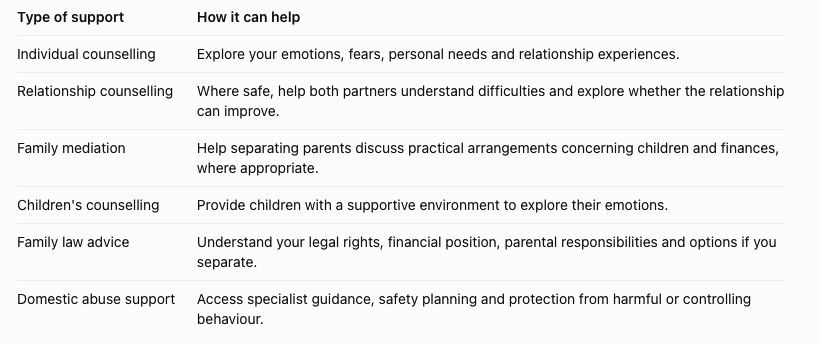
These services serve different purposes and can complement one another.
For example, you may choose to speak with a counsellor to explore your feelings while also consulting a solicitor to understand your practical and financial options.
You do not need to have made a final decision about your marriage before seeking either type of support.







What if there is domestic abuse or controlling behaviour?
It is particularly important to recognise that an unhappy relationship and an abusive relationship are not the same thing.
Domestic abuse can involve emotional, psychological, physical, sexual or financial abuse, as well as coercive and controlling behaviour.
Children can also be affected by experiencing the consequences of abuse within their home.
If you are concerned about your safety or the safety of your children, you should seek specialist confidential advice. Joint counselling or mediation may not be appropriate in these circumstances.
Support is available through:
National Domestic Abuse Helpline – Refuge
0808 2000 247
Respect Men's Advice Line
0808 801 0327
Karma Nirvana
0800 5999 247
Galop LGBT+ Domestic Abuse Helpline
0800 999 5428
Emergency services
999
Further information is available from GOV.UK – Domestic Abuse: How to Get Help. If you are concerned that your internet activity is being monitored, consider accessing support from a safe device.
Understanding your legal position before making a decision
One reason many parents remain in unhappy marriages is uncertainty about what separation would mean in practical terms.
You may have concerns about whether you can afford to live independently, whether you will need to leave the family home or how much time you would spend with your children.
Some of the questions you may want to discuss with a family law solicitor include:
- What could happen to the family home?
- How would arrangements for our children be decided?
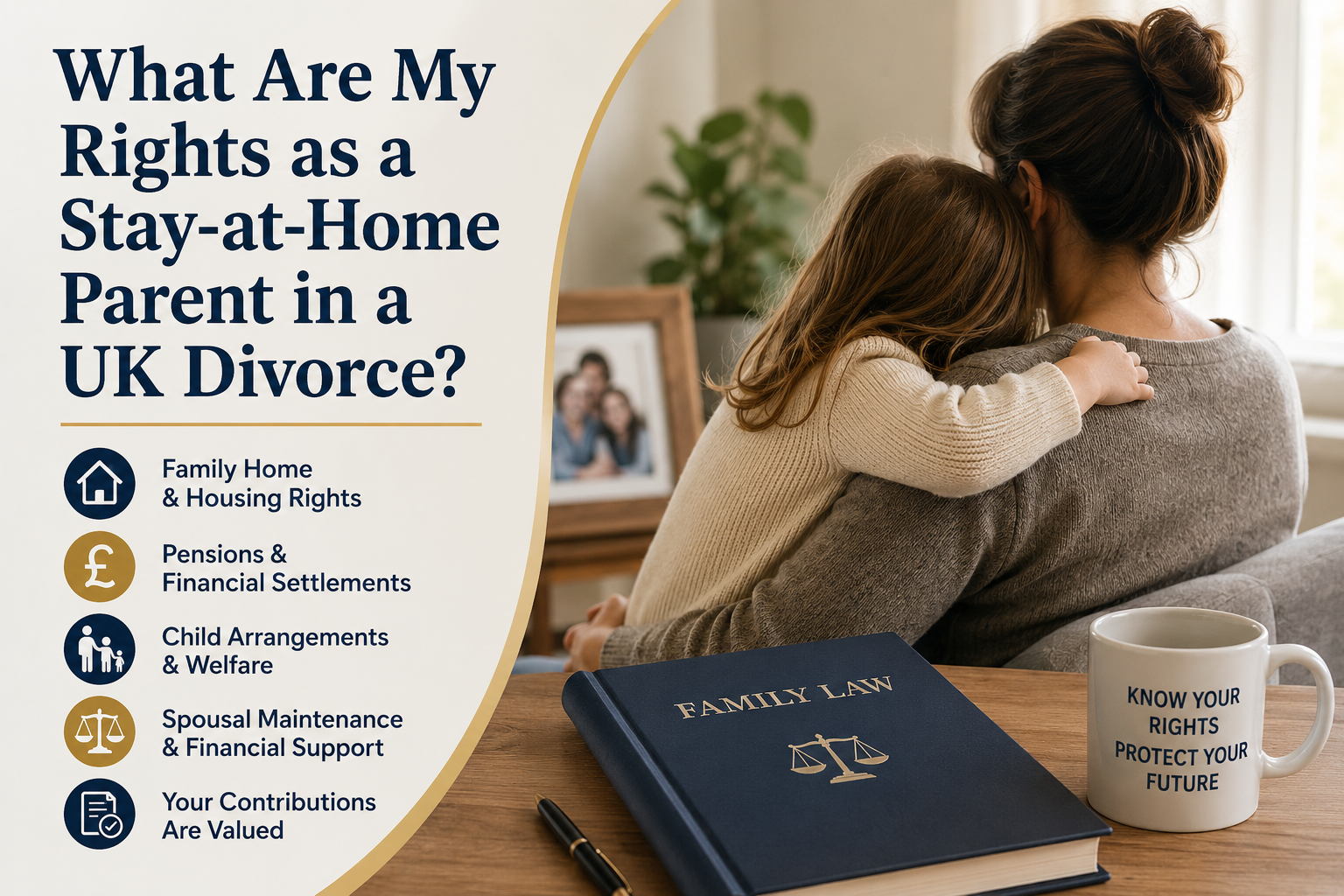
- What are my rights if I have been a stay-at-home parent?
- How might our savings, pensions and other assets be divided?
- What financial support might be available?
- Can we reach agreements without going to court?
- What happens if we cannot agree on arrangements for the children?
- What legal protections are available if I feel unsafe?
In England and Wales, the welfare of the child is the court's paramount consideration when determining relevant child arrangements. Arrangements should reflect children's individual needs, circumstances and safety.
Family mediation and other forms of dispute resolution may help parents reach agreements without contested court proceedings, where appropriate.
Understanding these matters in advance can help reduce uncertainty and allow you to consider your future from a more informed position.
Staying together or separating: making the right decision for your family
There is no single definition of a successful family.
Some families overcome significant relationship challenges and rebuild a loving partnership. Others develop healthier family relationships after separation.
The important thing is not necessarily preserving the original structure of your family at any cost. It is considering how everyone within that family can experience safety, respect, stability and emotional wellbeing.
You may decide that your marriage deserves another opportunity, supported by professional counselling and a shared commitment to change.
Alternatively, you may come to understand that separation is the most appropriate way forward.
Neither decision should be made solely because of pressure from others, fear of judgement or assumptions about what a family should look like.
Give yourself the opportunity to understand your circumstances, explore your options and make a considered decision.
You can seek advice without committing to divorce
At KLR Solicitors, we understand that parents considering separation are often carrying an enormous emotional and practical responsibility.
Our experienced family law solicitors provide a confidential environment where you can discuss your concerns, understand your legal rights and explore the options available to you.
Our free one-hour initial consultation is an opportunity to receive professional guidance without feeling pressured to make an immediate decision.
Whether you are simply considering your options, concerned about arrangements for your children or seeking clarity about your financial future, we are here to help.
Call KLR Solicitors on 020 8300 6666 to arrange your free one-hour consultation.
Sometimes, the first step towards making the right decision for your family is simply having a conversation with someone who understands your options.
This article provides general information relating to England and Wales and is not a substitute for individual legal advice, professional counselling or medical support.